


ICT Consequent Encroachment (Mean Threshold) — 50% of Fair Value Gap + Free PDF
Over 150 pages of knowledge coming from 8+ years of experience from Professional ICT Trader.
👉 Buy Now!
ICT consequent encroachment (CE) is the 50% retracement level of a fair value gap or any ICT PD array. It is also called the ICT mean threshold and acts as the most reactive level inside the gap — the level price most often respects when retracing.
Consequent encroachment is part of the Kesenjangan Nilai Wajar TIK and the Array PD TIK framework, so before diving deep into CE you should be familiar with the FVG.
This guide walks you through the meaning, identification, the trade flow, the difference between CE and mean threshold, the common mistakes traders make and the free PDF download.
What is ICT Consequent Encroachment?
Consequent encroachment is the 50% measure of an ICT fair value gap (or any Array PD in the ICT framework).
Being an ICT trader, you have likely noticed that you may miss a trade while waiting for a fair value gap or order block to be filled completely.
Michael Huddleston teaches that you do not need to wait for complete mitigation of a PD array to take a trade.
You identify the Consequent Encroachment level of the FVG and wait for price to mitigate that level for trade execution.
While price might not fully mitigate the FVG, there is a higher probability that it will address the consequent encroachment, providing an opportunity for trade entry.
How to Identify Consequent Encroachment
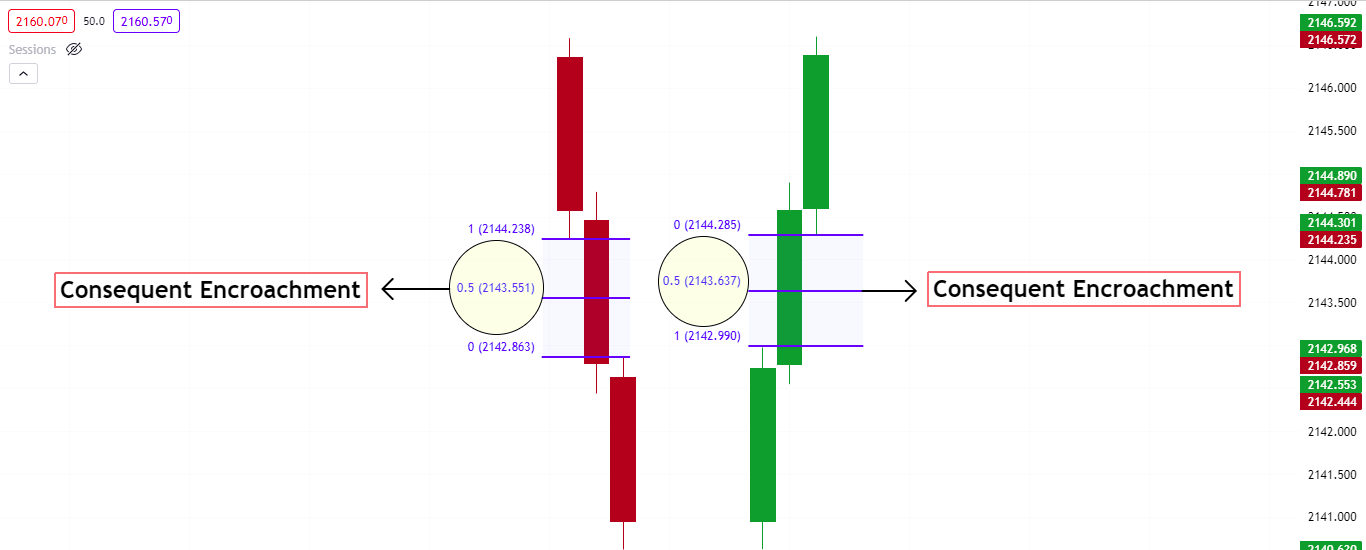
To identify an ICT consequent encroachment you have to find a fair value gap (bullish or bearish) and plot the Fibonacci tool from the high to the low of the FVG.
To find the consequent encroachment you need to set the following Fibonacci levels.
| 0 | Mulai |
| 0.5 (50%) | Akibat Perambahan |
| 1 | Akhir |
Now mark the 50% line of the Fibonacci tool — that is the consequent encroachment level of that FVG.
An illustration is given below to understand consequent encroachment.
In this post I focus on the consequent encroachment of a fair value gap, but you can find the CE of any ICT PD array — including the IFVG, bearish order block atau breaker block. The same 50% Fibonacci method applies in every case.

✨ Update: I've launched my ICT Trading Strategies PDF eBook! Check it out at ictpdf.com .
How to Trade Consequent Encroachment
To trade using the consequent encroachment of a fair value gap you need to know the following.
(I) Daily Bias
(II) PD Array
(III) Next Draw on Liquidity
After identifying these three elements you wait for price to test the PD array in the direction of the daily bias.
When price tests the PD array you drop to a lower timeframe and wait for a Pergeseran Struktur Pasar for confirmation of trade entry.
When the market has shifted the structure with a displacement move that leaves a fair value gap, you mark the consequent encroachment of that FVG.
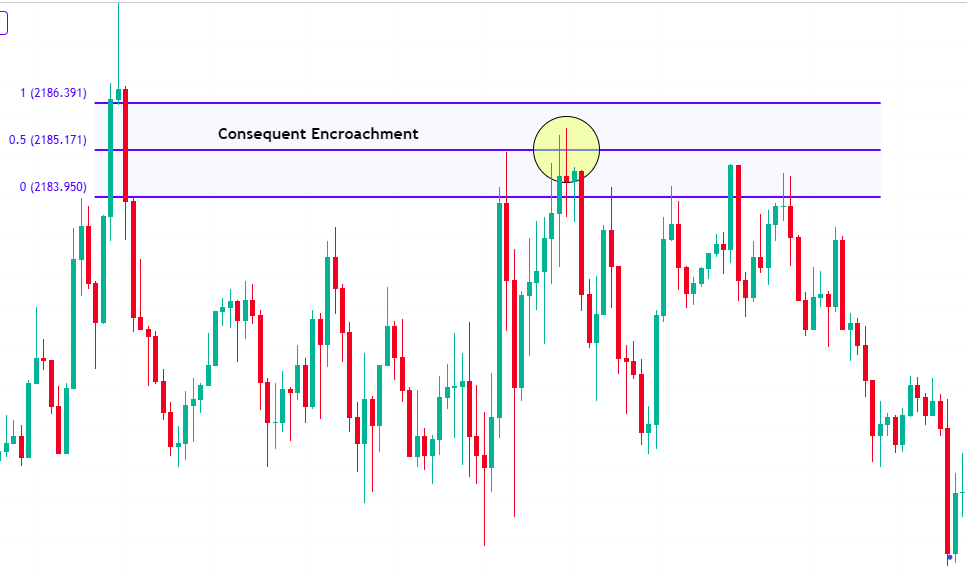
Then wait for price to test the consequent encroachment (CE) level — you can execute the trade when price mitigates the CE.
A live market example is attached below in which price respects the consequent encroachment level.
For the profit target you mark the next draw-on-liquidity level.
Step-by-Step Consequent Encroachment Trade Flow
This is the exact sequence I run when trading off the consequent encroachment.
- Set the daily bias. Bullish, bearish or neutral on the daily and H4.
- Identify the higher-timeframe PD array. Order block, FVG or breaker that price is drawn to, in the direction of the daily bias.
- Mark the next draw on liquidity. Old high/low or relative equal level beyond the PD array — this is the profit target.
- Wait for price to tap the PD array. Price must reach into the higher-timeframe PD array.
- Drop to the lower timeframe. 5-minute or 1-minute for the trigger.
- Wait for the MSS. A clean Market Structure Shift on the lower timeframe confirms the reversal.
- Mark the CE of the new FVG. Drop the Fibonacci from the FVG high to the FVG low and mark the 50% line — that is the CE.
- Enter at the CE retest. Wait for price to retrace into the consequent encroachment, then enter.
- Set the stop. Beyond the opposite edge of the FVG (or beyond the displacement candle’s high/low for tighter stops).
- Take profit at the draw on liquidity. The level identified in step 3.
Best Markets for Trading Consequent Encroachment
The CE works on every market that the ICT methodology is applied to, but the cleanest reactions print on a specific subset.
- NQ (NASDAQ futures) dan ES (S&P 500 futures) — the precision of US index price action makes the 50% level reactive almost to the tick.
- GBP/USD dan EUR/USD — London-killzone fair value gaps deliver clean CE reactions during the NY-AM retrace.
- XAU/USD (Gold) — the 50% mean-threshold reaction is particularly reliable on gold around 08:30 ET news releases.
For traders in the United States who follow the CFTC FIFO and no-hedge rules, the consequent encroachment works hand-in-hand with the 09:50 NY-AM macro window. Most macro setups deliver entries off the CE of the displacement FVG, which is why the 50% level is the single most useful reference inside intraday US session trading on NQ and ES.
Is it Necessary for Price to Test Consequent Encroachment?
No, it is not necessary for price to test the consequent encroachment level. Price may continue its move without any retracement, or price can cross the consequent encroachment level entirely.
Consequent encroachment is a highly reactive level, so it is important for you to pay attention to it — but it is not a guaranteed retest.
If price fails to reach the CE on the first leg, often the second leg of the move will deliver the retest. The CE remains a meaningful reference until price has fully passed through and printed structure on the other side of the FVG.
Can I Execute a Trade at Consequent Encroachment Without Any Confirmation?
You can execute a trade at the consequent encroachment level depending on your risk appetite.
But waiting for a trade confirmation at that level — typically a Market Structure Shift on a lower timeframe — increases your confidence. Secondly, you can layer your trades from the consequent encroachment level down to the Entri Perdagangan yang Optimal level (0.62 to 0.79), splitting the position across two prices for a better blended fill.
ICT Mean Threshold vs ICT Consequent Encroachment
ICT mean threshold and consequent encroachment are alternative terms for the same concept.
The 50% retracement level of an ICT PD array can be called the CE or the mean threshold — the two terms refer to the exact same line on the chart.
In ICT’s earlier teachings the term “mean threshold” was used more frequently, while “consequent encroachment” became dominant in the later mentorship videos. Both are valid; both describe the 50% midpoint of the gap.
Common Mistakes Around Consequent Encroachment
These are the recurring mistakes I see when traders first start trading off the CE.
- Drawing the Fibonacci on the wrong gap. The CE has to be plotted on the displacement FVG that follows the MSS — not on every random FVG visible on the chart.
- Entering at the CE without bias. The CE is a high-probability retracement level, but only when it sits inside a bias-aligned setup. A CE retracement against the daily bias is often a continuation, not a reversal.
- Treating the CE as a guarantee. Price may continue without retracing to the CE. Use the level as a reference, not as an unconditional entry.
- Ignoring the lower-timeframe MSS. The CE on its own is not a setup. The lower-timeframe Market Structure Shift is what turns the CE into a tradeable entry.
- Stop too tight. Stops parked exactly at the CE often get hunted on the second test. The opposite edge of the FVG is the conservative stop.
- Confusing CE with OTE. The CE is the 50% level of the FVG. The OTE is the 0.62 to 0.79 zone on a swing-based Fibonacci. They are related but not identical references.
ICT Consequent Encroachment PDF Download
You can download below ICT consequent encroachment in PDF for free. This PDF is sponsored by ICTPDF.COM.
To learn the complete ICT Trading strategy step by step, you can buy the E-book PDF Perdagangan TIK pada ICTPDF.COM.
FAQs about ICT Consequent Encroachment
Brief answers to the questions readers ask most often about the CE.
What is consequent encroachment in trading?
Consequent encroachment is the 50% measure of an ICT fair value gap or any PD array. It is the most reactive level inside the gap and the price level ICT traders most often watch for entries.
What does CE mean in ICT?
CE stands for Consequent Encroachment. It refers to the 50% midpoint of a fair value gap, an order block or any other PD array.
Is ICT mean threshold the same as consequent encroachment?
Yes — ICT mean threshold and consequent encroachment are alternative terms for the same concept. Both describe the 50% retracement level of a PD array.
How do I find consequent encroachment?
Plot the Fibonacci tool from the high to the low of the FVG. The 50% line is the consequent encroachment level.
Why is consequent encroachment important?
The 50% level of an FVG is statistically the most reactive level inside the gap. ICT teaches that you do not need to wait for full mitigation of the FVG — entering at the CE captures the move with a tighter stop.
Where do I place the stop loss on a CE trade?
The conservative stop sits beyond the opposite edge of the FVG. Tighter stops can sit beyond the displacement candle’s high or low.
Where is the take profit on a CE trade?
The next draw-on-liquidity in the direction of the trade — typically a relative equal high/low, the prior session high/low or an unfilled higher-timeframe FVG.
Is the CE the same as OTE?
No. The CE is the 50% level of an FVG. The OTE is the 0.62 to 0.79 zone of a swing-based Fibonacci. The two are related references but they are measured differently.
Does price always test the consequent encroachment?
No — price may continue without retracing or may cross through the CE entirely. The CE is a high-probability retest level, not a guaranteed one.
Can I trade the CE on indices and gold?
Yes — NQ, ES and XAU/USD produce some of the cleanest CE reactions, especially during the New York AM session and around US economic releases.
✨ Update: I've launched my ICT Trading Strategies PDF eBook! Check it out at ictpdf.com .


It is soo nice to read this article