


ICT One Trade Setup for Life — Five-Session Liquidity Raid Model & Step-by-Step Trade Flow

Over 150 pages of knowledge coming from 8+ years of experience from Professional ICT Trader.
👉 Buy Now!
ICT One Trade Setup for Life is a complete trading model that repeats every day across five session-based liquidity raids — PM session range, London session range, opening range gaps, New York lunch raid and the previous AM session as the target. If you master this single setup, you do not need any other model — it covers scalping and day trading in the same framework.
In this guide I walk you through the One Trade Setup for Life — the components, the five session raids, the daily-bias context, the step-by-step trade flow, the best timeframes, common mistakes and the FAQ.
You can jump to the section you are most interested in from below or continue reading the full article for a complete view.
What is ICT One Trade Setup for Life?
ICT One Trade Setup for Life is a complete trading model based on the following concepts.
(I) Bias Harian TIK
(III) PM Session Liquidity Raid
(IV) London Session Liquidity Raid
(V) Opening Range Gaps
(VI) New York Lunch Raid
(VII) AM Session Liquidity Raid
This setup repeats over and over again and can be used for scalping as well as day trading.
If you master the ICT One Trade Setup for Life, you do not need any other thing to trade — it is a complete model.
Before going forward, you need to understand what draw on liquidity means.
✨ Update: I've launched my ICT Trading Strategies PDF eBook! Check it out at ictpdf.com .
What is Draw on Liquidity?
Likuiditas means willing buyers and sellers at the current market price.
In trading terms, liquidity means the liquidation price of active traders — either sellers or buyers.

Draw on liquidity means hunting the liquidity of active traders — hitting their stop losses or activating their pending orders such as sell stops or buy stops.
Draw on liquidity is the sole purpose of price delivery.
How to Trade Using ICT One Trade Setup for Life
To trade using the ICT One Trade Setup for Life, follow the steps below as told by ICT himself, and set your TradingView time window to New York local time.
(I) PM Session Range
PM session range is the previous day’s price delivery. For the PM session range, look at the 01:30 PM to 04:00 PM (New York local time) range.
Mark the highest high and lowest low of the PM session range. Above the highest high rests the buy-side liquidity; below the lowest low rests the sell-side liquidity.
If your Bias Harian is bullish, anticipate price to run below the PM session range low to raid the sell-side liquidity and create an ICT Judas Swing.
If you are bearish, look for price to run above the PM session high for the liquidity raid and the ICT Judas Swing.
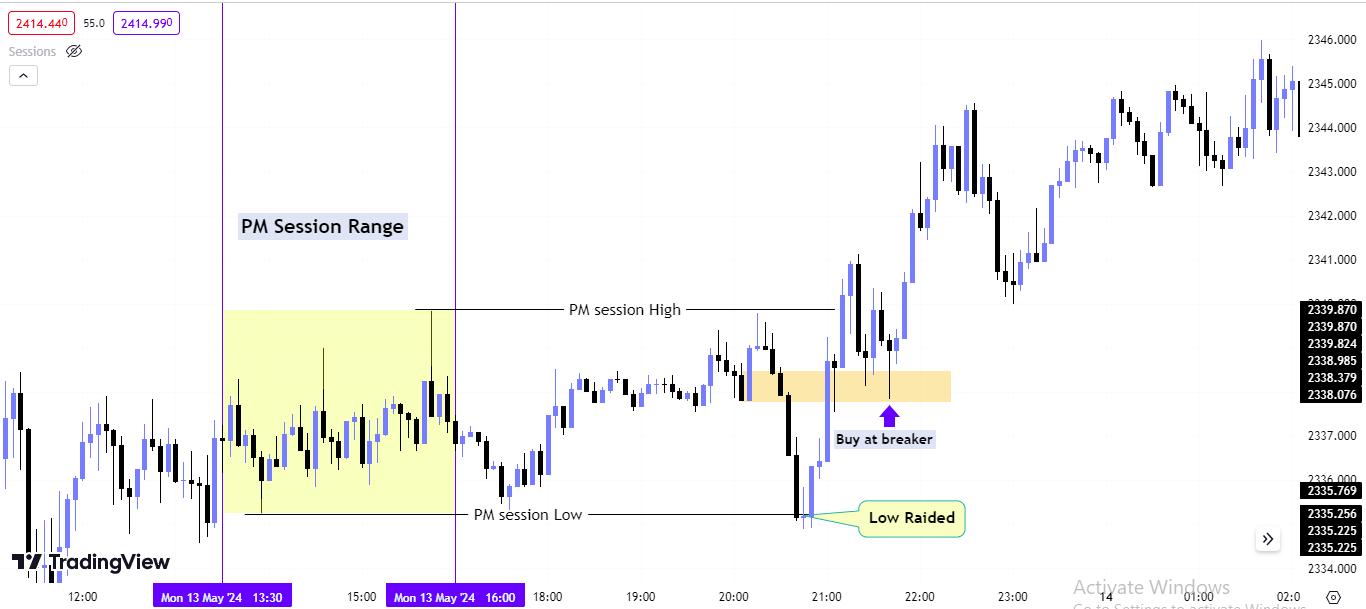
After the liquidity raid, wait for an Pergeseran Struktur Pasar TIK in the direction of your daily bias. Then execute a trade at the retest in the direction of your daily bias.
(II) London Session Raid
If the PM session is not a factor or price is far away from the PM session range, look for the London session liquidity raid for trade execution.
Mark the London session range 02:00 AM to 05:00 AM — highest high and lowest low.
On the New York opening, if you are bullish, anticipate a run below the low of the London session range for the sell-side liquidity raid.
If your daily bias is bearish, anticipate a run above the high of the London session range for the buy-side liquidity hunt.
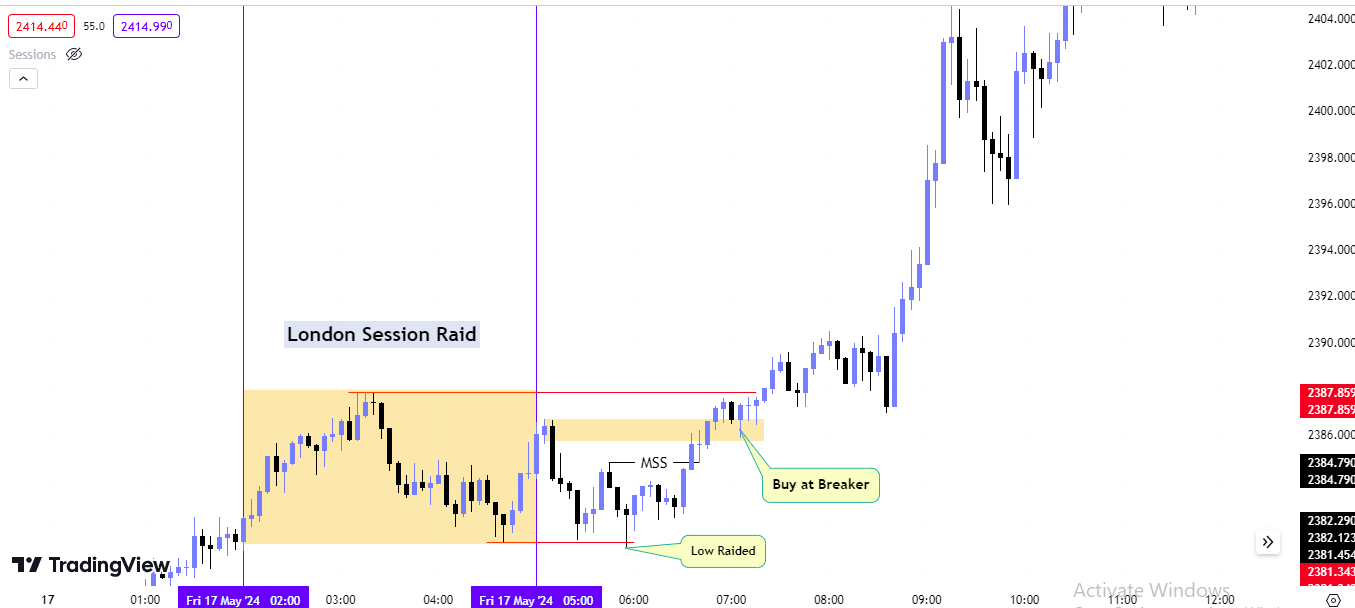
The process after the liquidity hunt is the same for every session — look for a market structure shift in the direction of your daily bias and then execute a trade on the retracement.
(III) Opening Range Gaps
The opening gap is the event that takes place when trading stops and the market reopens at 08:30 AM for forex and 09:30 AM (New York local time) for indices like Nasdaq and S&P500.
If your daily bias is bearish and price opens with a gap, wait until New York lunch hour — the algorithm engineers liquidity in the morning and during lunch hour at 01:30 PM NY local time.
After lunch hour, anticipate price to approach the opening gap and then sell off to take the liquidity engineered during the AM session and lunch hour.
(IV) New York Lunch Raid
If price has not done anything yet — no PM session raid, no London session raid, no opening gap range — look for the New York lunch raid.
Mark the New York lunch range (highest high and lowest low) from 12:00 PM to 01:30 PM (New York local time).
If you are bearish, look for the New York lunch range high to be raided for buy-side liquidity, and then a market structure shift to the downside to execute a sell trade.
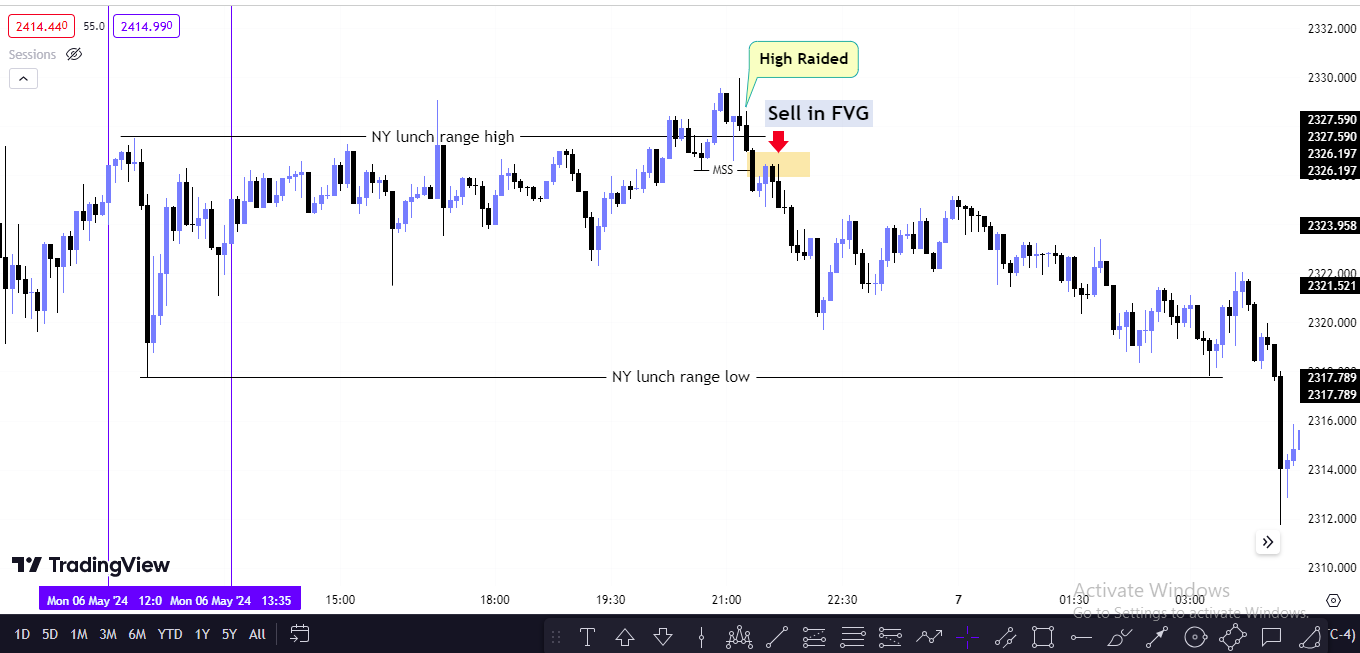
If your daily bias is bullish, look for the New York lunch range low to be raided for sell-side liquidity, and then a market structure shift to the upside to execute a buy trade.
(V) AM Session Liquidity Raid (Target)
The previous day’s AM session (09:30 AM to Noon) liquidity is the target.
If you are bullish and have the trade setup, your final target is the previous day’s AM session high.
If you are bearish and have the trade opportunity, your final profit target is the previous day’s AM session low.
Step-by-Step One Trade Setup Flow
This is the exact sequence I run every morning to find the One Trade Setup.
- Set your chart to New York local time. Every session range in the model is defined in NY time.
- Set the daily bias. 1-day and 4-hour structure plus the higher-timeframe PD array — bullish, bearish or neutral.
- Mark the previous day’s AM session high and low. 09:30 AM to Noon — this is the final target zone.
- Mark the PM session range. 01:30 PM to 04:00 PM of the previous day.
- Mark the London session range. 02:00 AM to 05:00 AM NY time of the current day.
- Mark the NY lunch range. 12:00 PM to 01:30 PM NY time once the period closes.
- Identify the opening range gap. Forex 08:30 AM, indices 09:30 AM — note the gap if present.
- Wait for the first session raid against your bias. Bullish bias — wait for a sell-side raid below one of the session lows. Bearish bias — wait for a buy-side raid above one of the session highs.
- Wait for the lower-timeframe MSS. 5-minute or 1-minute MSS in the direction of your daily bias after the liquidity raid.
- Enter on the retest. Take the trade in the bias direction at the post-MSS PD array.
- Set the stop. Beyond the swept session extreme, with a small buffer.
- Take profit at the AM session target. Bullish — previous AM session high. Bearish — previous AM session low. Use partial profits at the relative equal level along the way.
Best Pairs for ICT One Trade Setup
The One Trade Setup works on every major instrument that respects the New York session — GBP/USD, EUR/USD, USD/CAD, plus indices and metals.
For traders in the United States who follow the CFTC FIFO and no-hedge rules, the One Trade Setup maps cleanly onto NQ and ES futures (CME Group) plus regulated forex pairs through US-based brokers. The 09:50 NY-AM macro window is the highest-conviction window for the entry trigger because the algorithmic delivery is most concentrated there.
Common Mistakes Around the One Trade Setup
These are the recurring mistakes I see when traders first start trading the One Trade Setup.
- Wrong timezone. Every range is defined in New York local time. Using broker-server time or local time produces the wrong session ranges.
- Trading the first raid that prints, regardless of bias. The raid must align with your daily bias. A buy-side raid against a bullish bias is a stop hunt, not the setup trigger.
- Skipping the MSS confirmation. The session raid is the trigger zone — the entry is the post-raid lower-timeframe MSS. Do not enter on the touch of the session level alone.
- Marking the lunch range too early. The 12:00 PM to 01:30 PM range is only valid AFTER 01:30 PM. Marking it at 12:30 PM produces a half-formed range.
- Targeting the same-day AM session. The AM session target is the PREVIOUS day’s AM range, not today’s.
- Trading every session raid every day. The model is a “first opportunity wins” framework. Once one session triggers a clean trade, the rest of the day is monitoring — not new entries.
FAQs about ICT One Trade Setup for Life
Brief answers to the questions readers ask most often about the One Trade Setup.
What is the ICT One Trade Setup for Life?
A complete daily trading model based on five session-based liquidity raids — PM session, London session, opening range gap, NY lunch raid and the previous AM session as the target — anchored to the daily bias.
What time zone do I use?
New York local time. Every range in the model is defined in NY time.
What is the PM session range?
01:30 PM to 04:00 PM NY time of the previous day. Mark the highest high and lowest low — buy-side liquidity sits above the high, sell-side liquidity sits below the low.
What is the London session range?
02:00 AM to 05:00 AM NY time. Mark the highest high and lowest low for the New York open liquidity raid.
What is the NY lunch range?
12:00 PM to 01:30 PM NY time. Mark the highest high and lowest low. Used as the trigger range when no earlier session has produced a setup.
What is the AM session target?
The previous day’s 09:30 AM to Noon session high (bullish target) or low (bearish target). This is the final profit target of the model.
How does the daily bias fit in?
The daily bias decides which side of every session range you target. Bullish bias — sell-side raids below session lows. Bearish bias — buy-side raids above session highs.
Where do I enter?
After the session raid in the direction of your bias, wait for the lower-timeframe MSS, then enter on the retest of the post-MSS PD array. Not on the touch of the session level alone.
Where do I place the stop loss?
Beyond the swept session extreme, with a small buffer.
What timeframe is best for the entry trigger?
5-minute or 1-minute for the MSS. 15-minute for the post-MSS PD array.
Does this setup work on indices and gold?
Yes — NQ, ES and XAU/USD all respect the same session ranges, especially during the New York AM session and around US economic releases.
Why is it called One Trade Setup for Life?
Because the model repeats every day and covers every session — if you master it, you do not need a second strategy. It scales from scalping to day trading without changing the framework.
✨ Update: I've launched my ICT Trading Strategies PDF eBook! Check it out at ictpdf.com .


Assalamualaikum
Dear Previous day’s AM session liquidity raid timings are confusing. Do you mean NY session 09:30 to closing time (1700) ?
Its mentioned 09:30 AM to Noon(12:00 PM) NY Local time
please in tanzania the NY session and landon its what time
use sessions indicator in trading view with tanzania local time
Hello,I am pleased with this concept, l have burned more accounts and,l thought trading is impossible but now I come to the reality. I spent a long time on chart but sometime opportunities run without me,
I just wanna ask some explanation about valid BOS,what we can get as a confirmation of i
Which time frame used in this model
weekly and 15 minutes
Hello sir I appreciate your content all the time may almighty God bless you, To some extent I have been question,
On the chart provided for Newyork launch raid a wick of a candle swept liquidity (N.Y launch high) but it seems like you don’t consider it as a raid and prefer to the last liquidity fage that happened pls I need clarification dear
Thanks for pointing out.
After the 1st liquidity raid price did not shift the structure to the down side (swing low formed before liquidity raid was not broken).
then price swept the high of previous liquidity raid and shift the structure to down side.
Finally I have got my answer by coming over and over throughly it’s MSS
perfect